This guide is written for buyers, parents, educators, publishers, and children’s product teams who want a practical way to plan sticker story cards without overpromising performance or safety. The goal is to make the product easier to use, easier to source, and clearer for the final customer.
The basic system
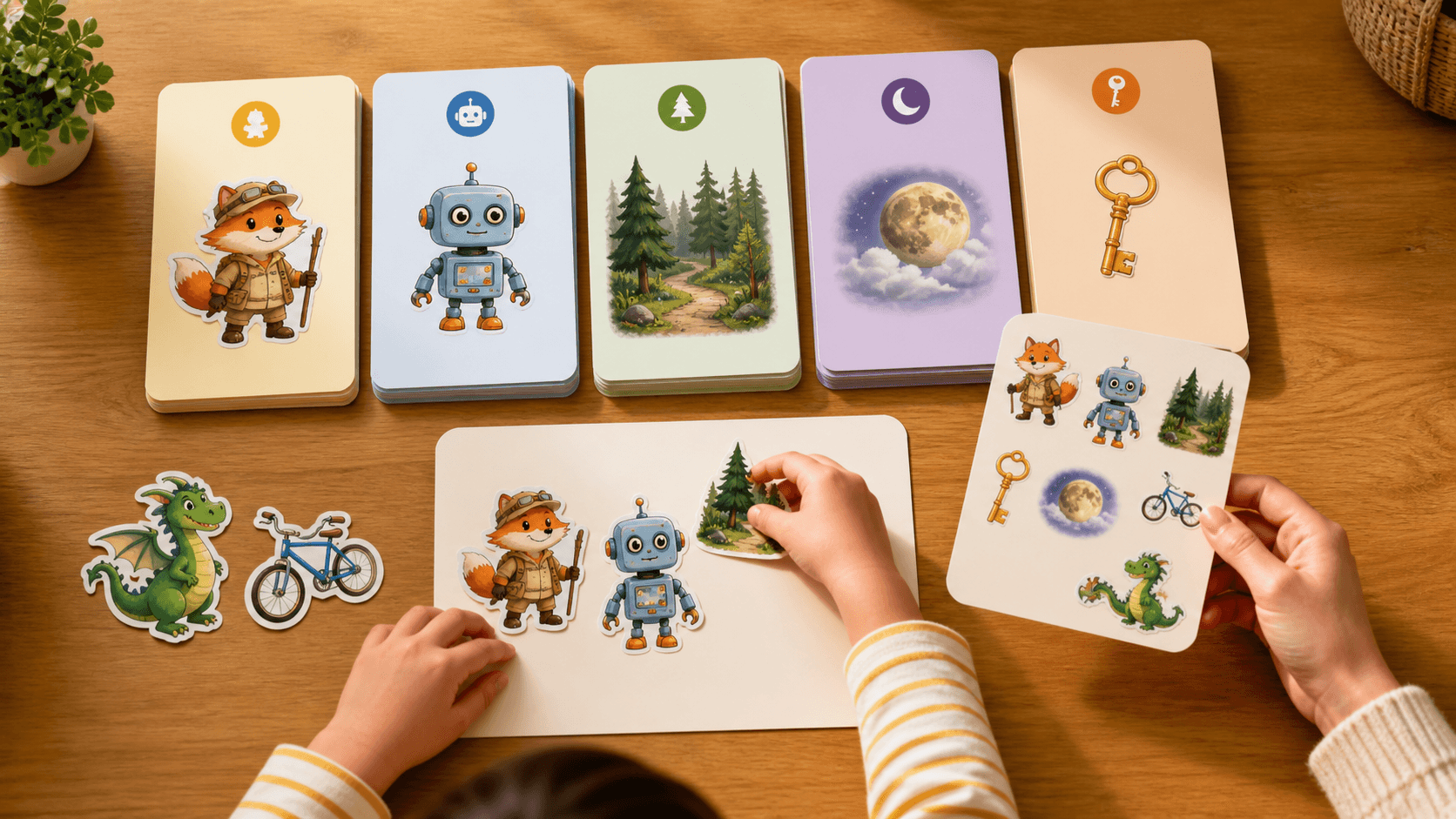
Children choose or draw from categories: character, setting, object, action, and twist. The stickers become story ingredients. A child might combine a sleepy dragon, a moon garden, a lost key, a race, and a surprise visitor. The goal is flexible storytelling, not one correct answer.
For wholesale or custom production, write down the intended user, destination market, quantity, packaging style, and any test requirements before artwork begins. This keeps design decisions connected to real buying conditions instead of guesswork.
Choose the delivery format
A card deck is portable. A fold-out board supports group play. A mini-book creates a take-home story record. Library and classroom programs may prefer reusable prompt boards while retail kits may use single-use sheets.
For wholesale or custom production, write down the intended user, destination market, quantity, packaging style, and any test requirements before artwork begins. This keeps design decisions connected to real buying conditions instead of guesswork.
Balance the categories
The set should create coherent but surprising combinations. Too many random objects can feel chaotic. Too few twists can feel repetitive. Include friendly characters, clear settings, useful props, action stickers, and optional emotion or problem cards.
For wholesale or custom production, write down the intended user, destination market, quantity, packaging style, and any test requirements before artwork begins. This keeps design decisions connected to real buying conditions instead of guesswork.
Make it inclusive and low-pressure
Use prompts that invite imagination without forcing personal disclosure. Avoid cultural stereotypes or fear-heavy scenarios. For multilingual groups, use icons, simple words, and optional writing space so pre-readers and early readers can participate.
For wholesale or custom production, write down the intended user, destination market, quantity, packaging style, and any test requirements before artwork begins. This keeps design decisions connected to real buying conditions instead of guesswork.
Planning table
| Category | Example stickers | Purpose |
|---|---|---|
| Character | Robot, rabbit, explorer, chef | Gives the story a main actor |
| Setting | Forest, market, moon, classroom | Creates the world |
| Object | Map, key, umbrella, seed | Adds a plot tool |
| Twist | Sudden rain, missing friend, secret door | Creates movement |
Buyer checklist
- Define the user age range and supervision context.
- Confirm product format, sheet size, piece count, and packaging.
- Avoid safety, waterproof, washable, food-contact, or skin-contact claims without test evidence.
- Prepare original or properly licensed artwork.
- Request a proof or sample before bulk production.
Related StickerJaki guides
- /diy-sticker-book-ideas/
- /stickers-for-kids-crafts/
- /custom-shape-stickers/
- /hand-drawn-stickers-in-the-ai-era/
FAQ
What are sticker story cards?
They are prompt cards or sticker sets that help children build stories from visual ingredients.
Can pre-readers use them?
Yes, if icons, simple categories, and oral storytelling options are included.
Are they only for writing?
No. They can support oral stories, family play, classroom circles, and library programs.
How many stickers should a set include?
A 40-sticker plan can work well when categories are balanced.
How do you reduce pressure?
Offer silly options, group storytelling, and no single correct answer.