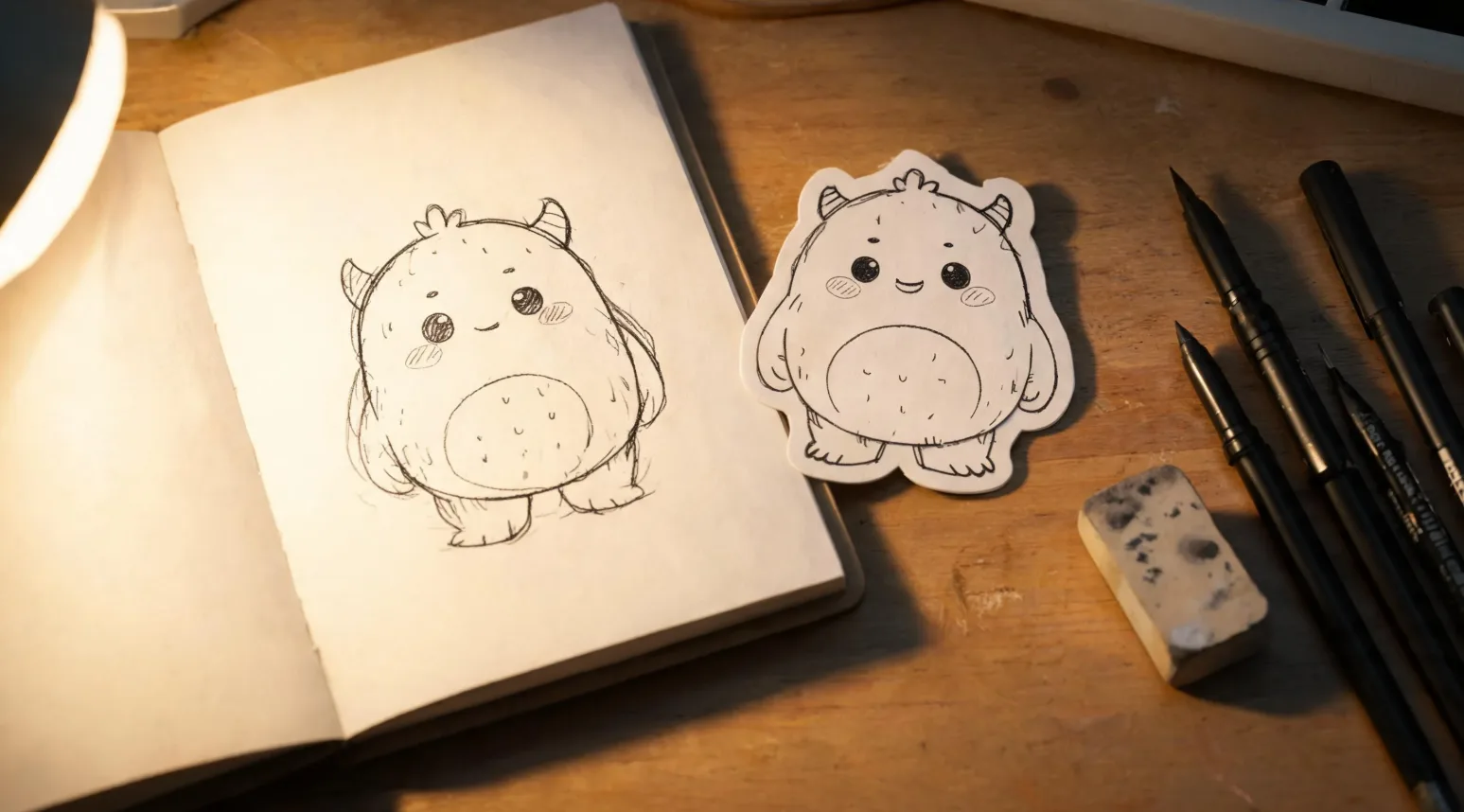
Hand-drawn stickers are having a moment because, in a feed full of AI-smooth imagery, work that visibly comes from a human hand instantly stands out and feels trustworthy. Design platforms have named the wider movement “imperfect by design.” This isn’t about AI being worthless — it’s that handmade character is a genuine differentiator right now. Here’s what makes it work and how to keep it print-ready.
Why hand-drawn is having a moment
When a style becomes effortless and everywhere, its opposite becomes valuable. AI can generate a polished illustration in seconds, so polish itself no longer signals effort or authenticity. Hand-drawn work does: a visible brush stroke or a slightly wobbly line reads as time, care, and a real person’s taste. For small brands and independent artists, that human signal is a competitive edge, not a limitation.
What makes a design read as human-made
Certain visual signals tell the eye “a person made this.” The table shows the main ones and how to keep them printable.
| Hand-drawn signal | Why it reads as authentic | How to keep it print-ready |
|---|---|---|
| Visible brush strokes | Shows physical, human mark-making | Scan or export at high resolution so texture survives |
| Uneven linework | Machines default to perfect; wobble reads human | Keep lines but ensure a clean, closed cut path |
| Hand lettering | Personal, warm, hard to fake | High-contrast against background for legibility |
| Paper or ink texture | Signals a real medium | Flatten texture into the artwork before printing |
| Asymmetry | Organic, not templated | Fine — just keep it inside the safe zone |
How to keep hand-drawn art print-ready
Charming does not mean low-resolution or hard to cut. The commonest mistake is treating “handmade” as an excuse for a messy file. Scan or photograph artwork at high resolution (300 DPI at final size), clean up stray marks, and make sure there’s enough contrast to read at sticker scale. Crucially, the cut line must be a clean, closed path even if the drawing inside is loose — a die-cutter needs a precise outline. For the technical side, see how to design a custom sticker and, if your art needs sharpening for scale, how to vectorize artwork.
Hand-drawn vs AI-generated: what buyers actually respond to
Both have a place. AI is a fast tool for ideation and backgrounds; hand-drawn is what buyers connect with emotionally and are willing to collect. The pattern in the market is that people pay a premium for work that feels personal and story-led, while treating generic AI output as disposable. The practical takeaway isn’t “never use AI” — it’s that a visible human touch is what makes a sticker feel worth keeping.
Design tips for artists selling hand-drawn sticker collections
- Lead with your hand: keep the linework and texture that only you make.
- Build a cohesive set: a recognisable style across designs invites collecting — see our sticker packs guide.
- Protect the print: high resolution in, clean cut path, good contrast.
- Tell the story: “hand-drawn by me” is a selling point — say it in your listing.
- Test small: a low-MOQ run lets you trial a collection before scaling.
Frequently asked questions
Why are hand-drawn stickers popular in 2026?
They stand out against AI-smooth imagery, feel authentic and personal, and buyers connect with and collect them.
Does hand-drawn mean lower print quality?
No — scan at high resolution and keep a clean cut path; the charm survives while the file prints sharp.
Hand-drawn or AI-generated for stickers?
Hand-drawn earns emotional connection and premium value; AI is a useful tool but reads as disposable on its own.
How do I keep hand-drawn art print-ready?
300 DPI at final size, clean up stray marks, ensure contrast, and give the die-cutter a precise closed outline.
Can I sell a hand-drawn sticker collection?
Yes — a cohesive, personal style sells well as a collectible set; test with a small run first.
Turn your hand-drawn art into stickers — we preserve every brush stroke.