
The most effective sticker marketing isn’t one clever placement — it’s the same logo seen again and again until it sticks in memory. For small brands without ad budgets, stickers are a rare tool that turns cheap repetition into real brand recognition. This is the strategy behind why it works, not just a list of where to put them.
Why repetition beats a single big campaign
A single billboard is seen once and forgotten. A sticker on a laptop is seen every day, by everyone near that laptop, for months. Small brands win not by being loud once, but by being present repeatedly in everyday spaces. Stickers are uniquely good at this: they’re cheap enough to distribute in volume, durable enough to keep showing up, and people choose to display them — turning customers into a distributed, long-running media network you didn’t have to pay for twice.
The psychology of seeing a logo 10 times
This works because of the mere-exposure effect: the more often people see something, the more they recognize, trust, and prefer it — even without consciously noticing. The first time someone sees your sticker, it’s noise. By the fifth or tenth time, it’s familiar; familiarity reads as legitimacy. A brand seen repeatedly in the wild feels established and trustworthy, even if it’s tiny. Repetition is the cheapest path from “never heard of them” to “oh, I keep seeing them” — and that recall is what drives a search or a purchase later.
Real-world patterns: how brands use sticker repetition
- Laptop culture (tech & SaaS): developer tools hand out stickers at events; thousands of laptops in cafés and offices become tiny billboards among exactly the right audience.
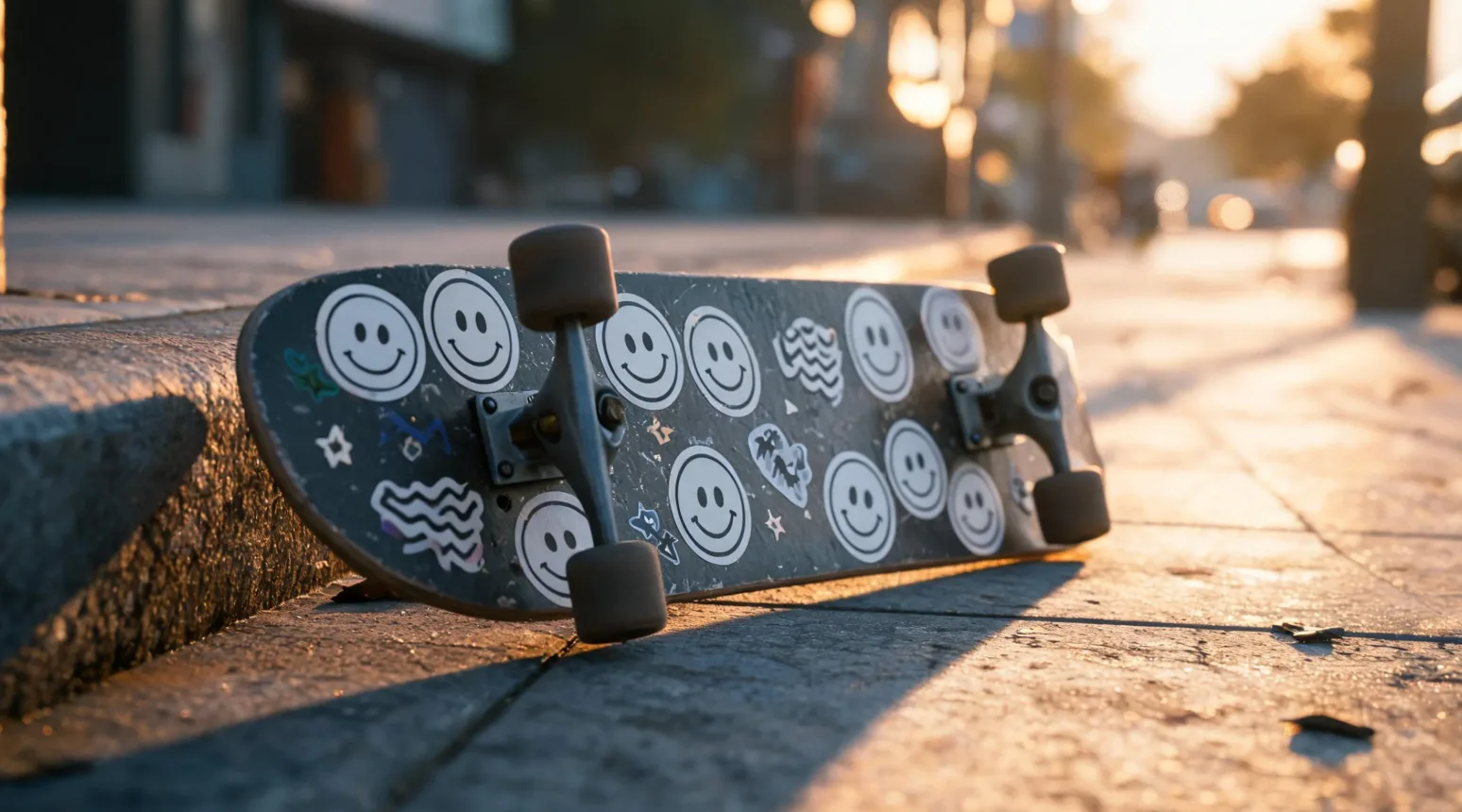
- Street & skate brands: bold die-cut logos placed in high-traffic urban spots build an authentic, “seen everywhere” subculture presence.
- Café & local loyalty: a cup sticker or laptop freebie keeps a local brand visible around the neighborhood and signals community belonging.
The common thread: one consistent design, distributed widely, seen repeatedly. This is a different play from the tactical use cases in our custom stickers for business guide — here the asset is repetition itself.
Where small brands place stickers for maximum recall
- Laptops, water bottles, phone cases — daily-carry items seen by many people.
- Packaging & orders — every shipment seeds another sticker into the wild.
- Events & communities — give them where your exact audience gathers.
- Partner counters — a bowl of free stickers at aligned local businesses.
Consistency is the multiplier: use one recognizable design so every impression compounds the same memory. Reordering the identical design in bulk keeps quality and color consistent across batches.
How to measure if it’s working
Repetition marketing is famously hard to attribute, but you can still track signals: a QR code or vanity URL on the sticker, a discount code given out with sticker drops, growth in branded search (people Googling your name), social tags and “where do I get this sticker?” comments, and direct/organic traffic lifts after distribution pushes. None is perfect alone; together they show whether recognition is building.
Common mistakes that waste sticker marketing budget
- Changing the design constantly — kills the repetition effect; pick one and stick with it.
- Over-designed, illegible logos — if it’s not recognizable at a glance, repetition doesn’t help.
- Hoarding them — undistributed stickers in a drawer market to no one; the goal is to get them out.
- Cheap stickers that fade or peel — a sticker that dies in a month stops repeating; durability is part of the strategy.
- No call to action or handle — make it easy for a curious viewer to find you.
Frequently asked questions
Do stickers actually work as marketing?
Yes — through repeated exposure. A single sticker seen daily for months builds recognition far more cheaply than a one-off ad, thanks to the mere-exposure effect.
How do stickers build brand recall?
By being seen repeatedly in everyday spaces. Familiarity grows with each impression, and familiarity reads as trust and legitimacy.
How many stickers should a small brand hand out?
Enough to create repeated impressions in your audience’s world — think in the hundreds, distributed widely, not a handful kept in a drawer.
Should I change my sticker design often?
No. Use one consistent, recognizable design so every impression reinforces the same memory.
How do I track sticker marketing results?
Use QR codes, vanity URLs or discount codes, and watch branded-search growth, social mentions, and organic traffic lifts after distribution.
Build your recognition campaign — reorder your design anytime with consistent quality.