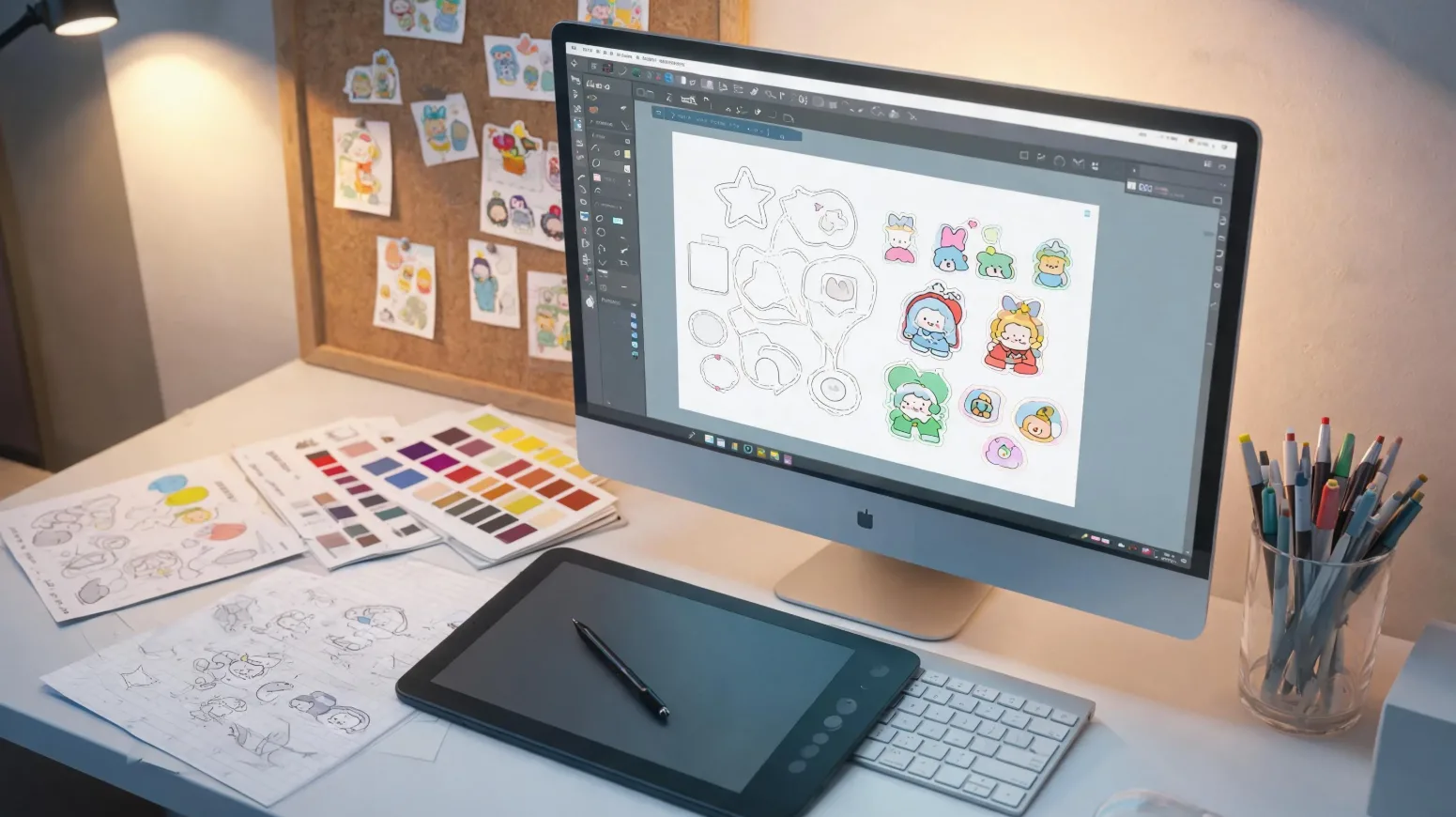
Great printing starts with a correctly set-up file. Get the size, bleed, and resolution right and your sticker prints exactly as designed — sharp edges, true colors, no surprises. This guide walks through the full artwork setup, accepted file types, and the six steps from idea to printed sticker.
At StickerJaki, a free design proof and a free design support team catch any file issues before printing — and we provide dieline templates so your setup is right the first time.
Step-by-step: set up your sticker artwork
1. Choose size & shape. Decide final dimensions and whether it’s die-cut (custom shape) or a standard shape. Bigger isn’t always better — match the size to where it’ll be applied.
2. Download a dieline template. Grab the correct dieline template for your size. It defines the cut line, safe zone, and bleed so nothing important gets trimmed.
3. Set up bleed (0.125″). Extend your background 0.125 inch (3 mm) beyond the cut line. Keep text and logos at least 0.125″ inside the cut line (the safe zone) so they’re never clipped.
4. Export at 300 DPI. Save as a vector PDF or AI (best) or a 300 DPI PNG. Use CMYK color for accurate printing. Outline fonts so they render correctly.
5. Submit for a free proof. Send your file and we’ll send a digital proof showing exactly how it’ll cut and print.
6. Approve & print. Confirm the proof and production begins — typically 3–5 days.
What file types do you accept?
| File type | Accepted? | Notes |
|---|---|---|
| AI | Yes — best | Native vector; ideal. Outline fonts. |
| Yes — best | Vector PDF preferred; keep bleed. | |
| SVG | Yes | Vector; great for clean shapes. |
| PNG | Yes | Use 300 DPI with transparent background. |
| JPEG | Limited | No transparency; only if 300 DPI and high quality. |
What bleed do stickers need?
Stickers need 0.125 inch (3 mm) of bleed on all sides — background color or imagery extended past the cut line. Cutting has a tiny tolerance, and bleed guarantees no white slivers appear at the edge. Pair it with a 0.125″ safe zone inside the cut line for all text and key elements.
What resolution is required?
Use 300 DPI at final print size for raster art (PNG/JPEG), or supply vector art (AI/PDF/SVG), which is resolution-independent and always crisp. Avoid upscaling small web images — they’ll print blurry.
Can I use Canva for sticker design?
Yes — Canva works if you export correctly: design at the final size, add a background that extends to the page edges for bleed, and export as a PDF Print or high-resolution PNG. For die-cut shapes, our team can add the cut line for you. If you’re unsure, send the file and we’ll set it up.
Get your artwork print-ready
Download free dieline templates or let our design team set it up for you — free proof included. Message us on WhatsApp or email contact@stickerjaki.com. See full specs in our sticker file requirements, explore design services, or start a custom order.
Buyer Notes for How to Design a Custom Sticker: File Setup, Bleed & Artwork Requirements
For custom sticker projects, buyers should confirm the intended size, finish, adhesive, packaging style, artwork format, and target order quantity before requesting a quote. StickerJaki focuses on carton-based wholesale supply, with standard product orders following MOV $200. Custom sticker pricing depends on the product type, material, finish, packaging, and quantity.
A strong custom order brief usually includes artwork files, target dimensions, application surface, finish preference, packaging expectations, and the quantity range you want quoted. Providing those details early reduces back-and-forth and helps the supplier recommend a practical production route instead of guessing from the artwork alone.
Quick sourcing checklist
- Confirm artwork format and color expectations
- Choose material, finish, size, and packaging style
- Share target quantity so pricing can be quoted accurately
For readers comparing options, the best next step is to move from general research to the right product or quote path. Useful resources: Custom sticker manufacturing · Wholesale sticker products · Contact StickerJaki.
If the standard product range does not match the exact design, packaging, or application requirement, a custom quote is usually the better path. In that case, prepare the artwork, expected quantity, target material, finish, and packing method before contacting the supplier.
Commercial Planning Notes
When a sticker idea moves from concept to production, the most useful question is not only “Can this be printed?” but “Can this be repeated consistently at the required quantity?” A custom project should be reviewed as a complete commercial item: artwork, material, adhesive, finish, cutting method, packing method, and final use all affect the quotation and the production plan.
Buyers can reduce sampling delays by preparing a simple specification sheet before asking for pricing. Include size, shape, number of designs, expected order quantity, packaging type, target market, and any durability requirement such as waterproofing, cold resistance, or outdoor use. If the artwork has small text, metallic effects, transparent areas, or white ink, mention that early because it may change the printing process.
For buyers comparing multiple sticker formats, the practical next step is to shortlist the intended use first, then match the product format to that use. Standard wholesale items are generally best for fast sourcing and retail assortments, while custom production is better when the design, material, dimensions, or packaging must follow a specific brand requirement.
Frequently Asked Questions
What details are needed for a custom sticker quote?
A useful quote request should include artwork, size, shape, material preference, finish, packaging method, expected quantity, and the surface or use case. These details help the supplier recommend the right production route and avoid vague pricing.
Is custom pricing the same as standard wholesale pricing?
No. Standard wholesale products follow carton-based pricing and MOV $200, while custom sticker pricing depends on the final specification, design count, material, finish, packaging, and quantity.
Should buyers order samples before production?
Samples are helpful when the order involves a new material, special finish, unusual adhesive requirement, or strict brand color. A sample check can reduce risk before committing to volume production.