
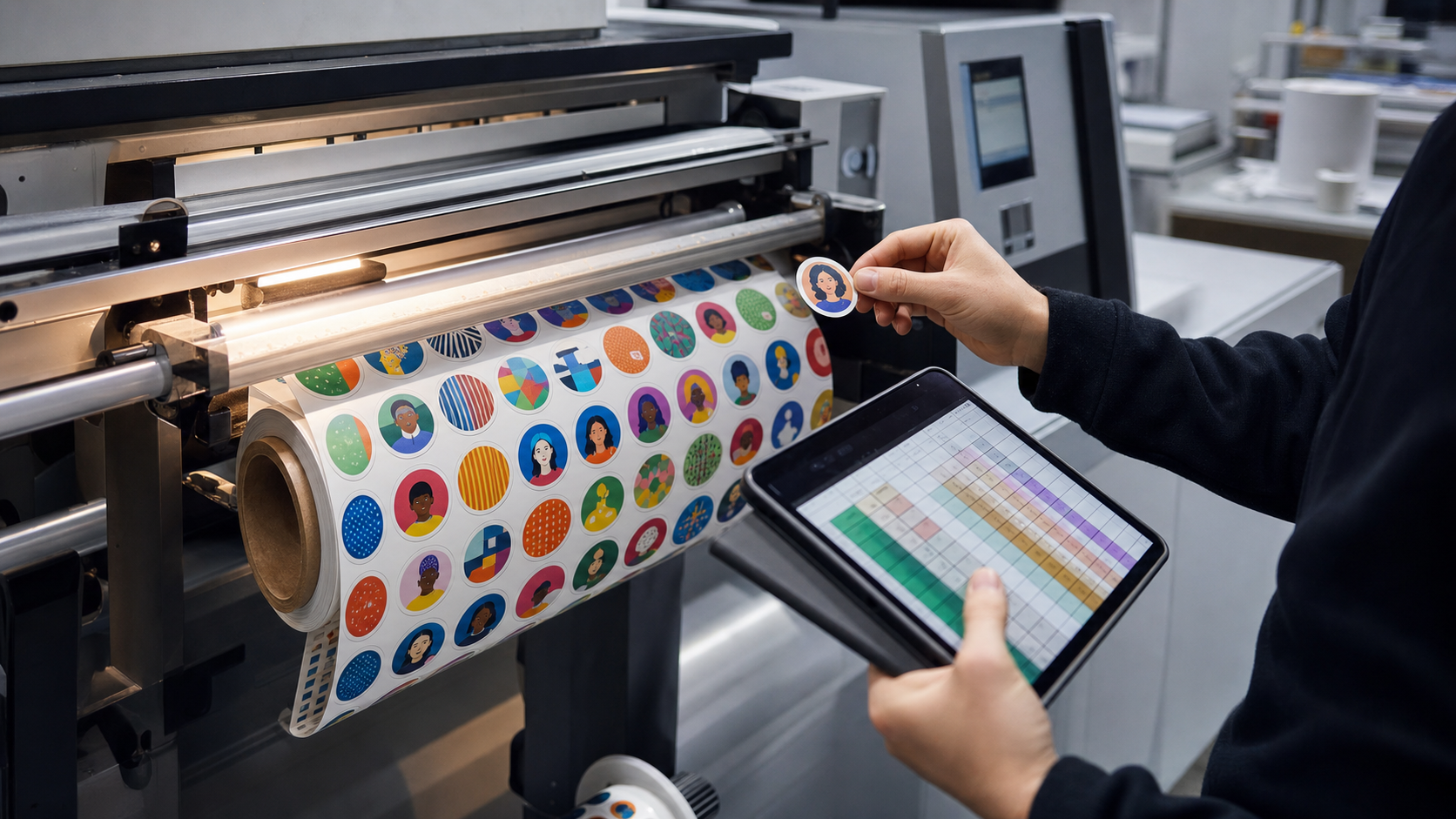
Variable data printing is one print run in which selected text, numbers, codes, colors, or images change from piece to piece. For stickers, it can turn one design template into hundreds or thousands of personalized labels.
What is variable data printing?
What is variable data printing? matters because buyers need a production decision, not just a pretty concept. For variable data printing stickers, the practical goal is to match design, material, quantity, and proofing to the way the sticker or label will be used.
The safest approach is to define the use case first, then check artwork, material, surface, version details, and approval steps before moving into a larger order.
What can change on each sticker?
What can change on each sticker? matters because buyers need a production decision, not just a pretty concept. For variable data printing stickers, the practical goal is to match design, material, quantity, and proofing to the way the sticker or label will be used.
The safest approach is to define the use case first, then check artwork, material, surface, version details, and approval steps before moving into a larger order.
Variable Data Use Cases
| Variable field | Business use | Required source data | Key QA check |
|---|---|---|---|
| Name | Personalized gifts | Clean name list | Spelling and length |
| Serial number | Limited editions | Start/end sequence | No duplicates |
| Batch code | Product labels | Batch table | Correct code |
| QR code | Campaign or tracking | URL list | Scan test |
Best business uses for personalized labels
Best business uses for personalized labels matters because buyers need a production decision, not just a pretty concept. For variable data printing stickers, the practical goal is to match design, material, quantity, and proofing to the way the sticker or label will be used.
The safest approach is to define the use case first, then check artwork, material, surface, version details, and approval steps before moving into a larger order.
How to prepare a clean data file
How to prepare a clean data file matters because buyers need a production decision, not just a pretty concept. For variable data printing stickers, the practical goal is to match design, material, quantity, and proofing to the way the sticker or label will be used.
The safest approach is to define the use case first, then check artwork, material, surface, version details, and approval steps before moving into a larger order.
Proofing and quality control before the full run
Proofing and quality control before the full run matters because buyers need a production decision, not just a pretty concept. For variable data printing stickers, the practical goal is to match design, material, quantity, and proofing to the way the sticker or label will be used.
The safest approach is to define the use case first, then check artwork, material, surface, version details, and approval steps before moving into a larger order.
FAQ
What is the main idea behind variable data printing stickers?
Variable data printing is one print run in which selected text, numbers, codes, colors, or images change from piece to piece. For stickers, it can turn one design template into hundreds or thousands of personalized labels.
What should buyers prepare before production?
Prepare final artwork, product or package details, size, material preferences, quantities, and any version-specific information.
What mistake should be avoided?
Avoid approving a design based only on screen appearance without checking material, size, version, and production requirements.
Can this be tested before scaling?
Yes. A controlled proof, sample, or pilot run can reveal issues before a larger order.
Ready to prepare your sticker project?
Ask whether your names, numbers, or artwork variants can be produced from one organized data file. Contact StickerJaki for custom sticker support: /custom/
How to turn the idea into a production-ready brief
For personalized label runs, the strongest decision is the one that can be checked before production. Treat variable data printing stickers as a production planning topic, not only a design preference. Your brief should explain the product, the surface, the expected use environment, the quantity range, and the parts of the artwork that cannot change. Add notes about data file, names, serial numbers, QR codes so the production team knows what to review first.
A useful brief is specific without being overcomplicated. Instead of saying that the sticker should look premium, explain the finish, size, viewing distance, packaging surface, and whether the customer needs to scan, read, peel, collect, or display the sticker. Those details shape material choice, file setup, and proofing.
Questions to answer before asking for a quote
- What surface or package will the sticker be applied to?
- Will the sticker be decorative, functional, promotional, or regulatory?
- Which part of the artwork is brand-critical or technically sensitive?
- What quantity range is being tested now, and what could be reordered later?
- Does the buyer need one design, multiple variants, or future monthly updates?
These questions help prevent vague quotes. They also make it easier to compare options because every supplier is responding to the same production situation. When the use case is clear, the discussion can move from abstract price shopping to practical fit.
What to check in the artwork file
Artwork for variable data printing stickers should be reviewed at final size. Small type, thin lines, complex patterns, QR codes, white layers, dense colors, and cut paths can all behave differently when the file moves from screen to material. Zooming in is helpful for technical inspection, but zooming out is just as important because buyers need to know what a customer will actually notice first.
Check that text is outlined or packaged correctly, images are high enough resolution, bleed extends beyond the cut line, and the safe area keeps important information away from the edge. If several versions are involved, confirm that each file has a clear name and that obsolete versions are removed from the approval folder.
Material, finish, and real-use testing
Material choice changes the result as much as artwork does. A glossy film, matte label, transparent stock, metallic base, or textured paper can shift the look and performance of personalized label runs. Adhesive and finish should be chosen for the surface and handling conditions, not just for how the mockup looks.
When the sticker will face moisture, cold, oil, rubbing, sunlight, curved packaging, or repeated handling, a real-use test is worth more than a perfect screen preview. Apply a sample to the actual surface, wait long enough to reveal edge lift or color issues, and check the result under the lighting where the product will be seen.
How to review the proof without missing the obvious
Proof approval should be slow and boring in the best way. Read every word, check every number, confirm the size, inspect the cut line, compare the quantity, and make sure the correct version is attached. Many expensive mistakes are not exotic print failures; they are old filenames, wrong SKUs, missing bleed, or a last-minute copy change that never reached the final proof.
For variable data printing stickers, the proof should also be checked against the original business goal. If the goal is readability, test readability. If the goal is shelf impact, view it at shelf distance. If the goal is production consistency across variants, compare the variants side by side instead of approving each one in isolation.
Common mistakes that slow down production
- Approving a mockup instead of the production file.
- Sending several file versions without naming the final one clearly.
- Ignoring the surface, storage condition, or application method.
- Using color as the only identifier for variants or warnings.
- Changing copy after proof approval without restarting the check.
A clean process does not remove creativity. It protects it. The more precisely the production details are handled, the more freedom the design has to work as intended when it becomes a real sticker, label, seal, or packaging element.
A practical approval workflow
Start with one owner for the final file and one owner for the final business approval. Collect feedback in one place, resolve contradictions, and avoid sending piecemeal comments through multiple channels. Once the artwork is ready, ask for a proof, review it against the checklist, and only then approve production.
That workflow is especially useful for personalized label runs, where design details and production details meet. It gives the buyer a repeatable way to move from idea to approved order without relying on memory or guesswork.
Final buyer checklist before production
Before a sticker or label project moves into production, the buyer should be able to explain the goal of the piece in one sentence. Is it meant to identify a product, protect a package, decorate a surface, support a campaign, or test a new product idea? That goal determines which details deserve the most attention during proofing.
- Confirm the final size and whether the artwork is viewed up close, at shelf distance, or in a photo.
- Check material and finish against the actual surface, storage condition, and handling environment.
- Review every text field, code, variant name, color cue, and production note against the latest source file.
- Make sure the approved proof, image reference, and quantity all describe the same version.
- Keep a simple record of what was approved so future reorders do not restart from guesswork.
This checklist is intentionally practical. Most production issues are not caused by one dramatic mistake; they come from several small assumptions stacking up. A color is assumed to match the screen, a label is assumed to fit the curve, a version is assumed to be final, or a proof is approved before someone checks the small text. Slowing down at the approval stage usually saves more time than it costs.
For B2B sticker and label buyers, the best results come from treating artwork, material, proofing, and reorder planning as one connected workflow. A clear workflow helps the supplier recommend the right production route, and it gives the buyer a reliable way to approve the project with confidence.
Buyer Notes for Personalized Stickers at Scale: A Beginner's Guide to Variable Data Printing
For custom sticker projects, buyers should confirm the intended size, finish, adhesive, packaging style, artwork format, and target order quantity before requesting a quote. StickerJaki focuses on carton-based wholesale supply, with standard product orders following MOV $200. Custom sticker pricing depends on the product type, material, finish, packaging, and quantity.
A strong custom order brief usually includes artwork files, target dimensions, application surface, finish preference, packaging expectations, and the quantity range you want quoted. Providing those details early reduces back-and-forth and helps the supplier recommend a practical production route instead of guessing from the artwork alone.
Quick sourcing checklist
- Confirm artwork format and color expectations
- Choose material, finish, size, and packaging style
- Share target quantity so pricing can be quoted accurately
For readers comparing options, the best next step is to move from general research to the right product or quote path. Useful resources: Custom sticker manufacturing · Wholesale sticker products · Contact StickerJaki.
If the standard product range does not match the exact design, packaging, or application requirement, a custom quote is usually the better path. In that case, prepare the artwork, expected quantity, target material, finish, and packing method before contacting the supplier.


