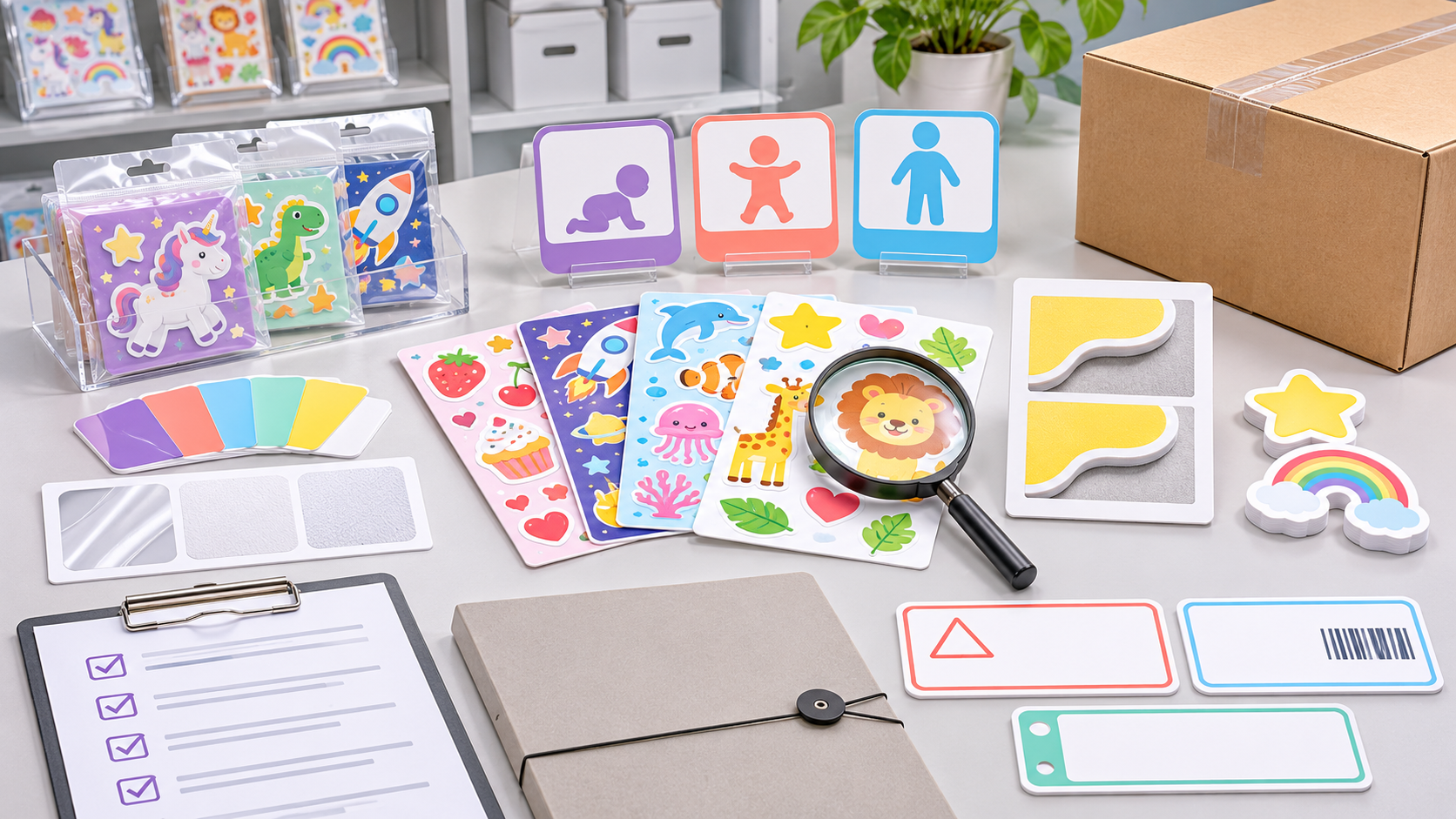
Are stickers safe for kids? The responsible answer depends on the specific product, intended age, construction, use, packaging, destination market, and supporting evidence. A colorful design or a general “non-toxic” claim is not enough for a purchasing decision. Importers and retailers should define the intended use, inspect samples, review product-specific documents, and confirm their own market responsibilities.
Define intended use and age grading
Start by recording who will use the product and how. A flat decorating sticker, a sticker book, a nail or skin-contact item, a raised novelty sticker, and a multi-component activity set may require different questions. Consider whether an adult supervises use, whether small detachable parts are present, and whether the product could be handled by children younger than the intended user. Age grading should be supported by the actual construction and use, not selected only for marketing.
Review construction and small-part considerations
Inspect sticker size, backing, layers, raised components, moving pieces, accessories, and packaging. Look for detachable parts, sharp or rough edges, damaged seals, loose decorations, and components that can separate during expected handling. Where a product includes several pieces, identify which items are part of the play or activity and which are packaging.
Ask for evidence about materials, inks, coatings, and adhesives
Buyers often ask for “child-safe materials” or “non-toxic stickers for kids,” but these phrases must be supported by product-specific evidence and an applicable requirement. Request information tied to the ordered SKU or confirmed custom specification. Check whether the evidence covers the relevant materials, inks, coatings, adhesives, and intended contact. Avoid extending a claim from one product to a different construction.
Perform physical and durability checks
Sample review should include print condition, cutting, edges, peelability, backing separation, adhesive transfer, surface damage, odor where relevant, and durability during expected use. Raised, liquid, shaker, or squishy products need additional checks for leakage, seam damage, deformation, recovery, and loose internal or external components. Define inspection methods before production rather than deciding after goods arrive.
| Safety check | Evidence to request | What to verify | Common red flag |
|---|---|---|---|
| Product identity | SKU, specification, approved sample | Documents match the ordered item | A report refers to another model |
| Age and intended use | Age grading and use description | Construction supports the stated use | Age is chosen without product review |
| Materials and chemicals | Relevant product-specific test evidence | Scope, parts, market, date, and result | Only a generic supplier statement is provided |
| Physical construction | Sample and inspection criteria | Edges, detachable parts, seals, durability | Loose parts or damaged raised areas |
| Packaging and warnings | Artwork and label proof | Language, warning, traceability, importer data | Required space or translation is missing |
| Shipment quality | Pre-shipment inspection record | Lot, quantity, defects, and packaging | Inspection cannot be tied to the shipment |
Packaging, warnings, and traceability
Packaging should protect the product and communicate required information. Review warning placement, language, age information, use instructions, barcode, batch or traceability information, supplier or importer details, and space for destination-market labels. A small retail pack may need layout planning to fit all required information without hiding the product.
How to review test reports and documents
When a report is provided, confirm the product name or model, photographs, tested components, applicable market or method, laboratory, report date, test scope, and result. Standards such as EN 71, ASTM, or CPSIA may be relevant in some situations, but they do not automatically apply to every sticker, classification, age, or destination. The buyer or importer should determine applicable requirements and obtain professional compliance advice when classification is uncertain.
Sample and pre-shipment inspection
Approve a sample or proof that represents the intended specification. Record dimensions, construction, artwork, colors, packaging, labels, and critical defects. Before shipment, inspect a defined sample across cartons and compare it with the approval standard. Keep inspection findings connected to the production lot and purchase order.
Destination-market responsibilities
Supplier documents and buyer responsibilities are not the same. A supplier can provide available product information and order-specific evidence, but the importer must confirm classification, labeling, documentation, and sale requirements in the destination market. Provide the market, intended age and use, packaging, and requested testing scope during quotation.
Buyer safety checklist
- Identify the exact SKU or confirmed custom specification.
- Define intended age, use, supervision, and destination market.
- Review size, layers, detachable parts, edges, seals, and accessories.
- Request evidence that matches the actual product and relevant components.
- Check packaging artwork, warnings, language, labels, and traceability.
- Approve a representative sample and written inspection criteria.
- Confirm pre-shipment inspection and retain order records.
- Consult a compliance professional when legal applicability is uncertain.
Explore current kids stickers wholesale, sticker books, and creative sticker sets as product references. Product documents and requirements must still be confirmed for the selected item and market.
Frequently asked questions
What age are stickers suitable for?
Suitability depends on product size, construction, components, use, warnings, and destination requirements. Review each item individually.
Are sticker adhesives safe for children?
Do not rely on a general claim. Request relevant evidence for the ordered product and intended contact.
How do I know whether a test report applies?
Match the report’s model, photos, components, scope, market, date, and result to the ordered item.
Are stickers safe for toddlers?
Do not assume so. Review age grading, small parts, intended use, supervision, packaging, and applicable professional advice.
What documents should a buyer keep?
Keep the specification, artwork approval, purchase order, product evidence, packaging proof, inspection record, and shipment traceability information.
Before ordering, send the product or SKU, intended age, destination market, quantity, packaging, and required documents through the quote cart, WhatsApp, email, or Contact page. See About StickerJaki, the Custom page, and the FAQ for more information.