
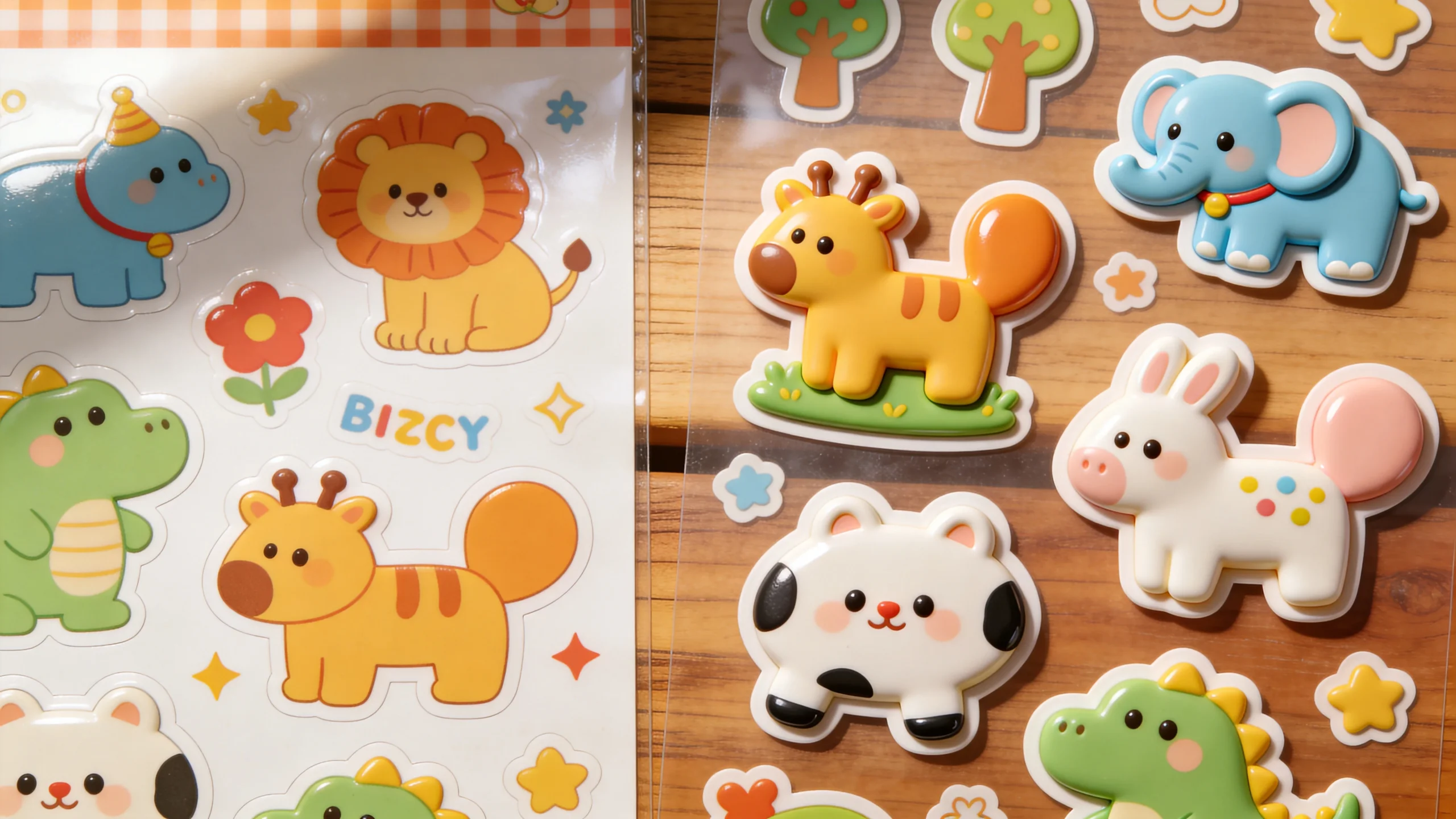
Both 3D stickers and regular stickers have their place, but choosing wrong can mean wasted money or missed impact. Here’s a practical comparison.
What’s the Difference?
Regular stickers are flat — printed on paper or vinyl, sometimes with a glossy or matte finish. They lie flush against any surface.
3D stickers are raised — usually with embossing, foam backing, or molded silicone. They protrude 1–5mm above the surface, creating a tactile, dimensional effect.
3D Stickers: The Pros
- Premium feel. Customers perceive them as higher value (often 2–3x markup).
- Eye-catching. Light interacts with depth — great for retail displays.
- Tactile. Kids and adults alike want to touch them.
- Decorative impact. Wall décor, gift wrap, statement accents.
3D Stickers: The Cons
- Higher cost. Manufacturing requires extra steps.
- Heavier. Shipping costs more.
- Limited applications. Don’t work on journals (won’t close), small surfaces, or anything that stacks.
- Slower bulk application. Each one needs individual placement attention.
Regular Stickers: The Pros
- Lower cost. 30–70% cheaper for the same design size.
- Universal fit. Stack, scan, fit in envelopes, attach to flat surfaces.
- Bulk-friendly. Apply 100+ in minutes.
- Print flexibility. Easy to update designs and runs.
When to Choose Which
Use 3D stickers for: retail packaging that needs to stand out, gift wrap, kids’ room décor, premium product launches, statement scrapbook accents.
Use regular stickers for: bullet journals and planners, classroom reward charts, branding at scale (1,000+ pieces), mailing labels, giveaways.
Cost Comparison (Wholesale, ~50mm size)
- Regular paper: $0.05–0.15 each
- Regular vinyl: $0.10–0.25 each
- 3D embossed: $0.25–0.60 each
- 3D silicone: $0.40–1.00 each
For impact and premium feel, 3D wins. For volume and versatility, regular stickers are unbeatable. StickerJaki carries both — including our signature 3D Relief Sticker series for retail and event applications.
Buyer Notes for 3D Stickers vs Regular Stickers: Which One Should You Choose?
For raised or dimensional sticker products, buyers should compare the surface effect, sheet size, carton quantity, and packaging format so the final assortment fits the selling channel. StickerJaki focuses on carton-based wholesale supply, with standard product orders following MOV $200. Custom sticker pricing depends on the product type, material, finish, packaging, and quantity.
Dimensional sticker products are often purchased for shelf impact, so buyers should look beyond the artwork and compare the height, gloss, flexibility, sheet layout, and retail packaging. The best option is usually the one that balances tactile appeal with repeatable carton supply.
Quick sourcing checklist
- Compare raised effect, gloss, flexibility, and sheet size
- Check carton quantity and retail packaging format
- Plan designs as a coordinated series when possible
For readers comparing options, the best next step is to move from general research to the right product or quote path. Useful resources: 3D relief stickers wholesale · Regular stickers wholesale · Custom sticker manufacturing.
If the standard product range does not match the exact design, packaging, or application requirement, a custom quote is usually the better path. In that case, prepare the artwork, expected quantity, target material, finish, and packing method before contacting the supplier.
Commercial Planning Notes
Dimensional stickers are usually chosen for touch, shine, and shelf impact. That means buyers should evaluate the physical sample, not only the digital proof. Raised surfaces, dome clarity, embossing depth, flexibility, and edge quality all influence how premium the sticker feels in a retail pack.
For wholesale programs, a 3D sticker line works best when the designs form a coherent series. Buyers should consider whether the carton assortment has enough variety, whether the packaging explains the effect clearly, and whether the item can be displayed easily. These practical details often decide whether a visually attractive sticker also performs well commercially.
For buyers comparing multiple sticker formats, the practical next step is to shortlist the intended use first, then match the product format to that use. Standard wholesale items are generally best for fast sourcing and retail assortments, while custom production is better when the design, material, dimensions, or packaging must follow a specific brand requirement.
Frequently Asked Questions
Why choose 3D stickers instead of flat stickers?
3D stickers add raised texture, shine, and tactile appeal, which can make a sticker product feel more premium and more noticeable in retail packaging.
What should buyers check in 3D sticker samples?
Review embossing height, gloss, edge quality, flexibility, adhesive strength, sheet layout, packaging style, and whether the assortment feels consistent as a retail product.
Are 3D stickers suitable for wholesale programs?
Yes. They work well for stationery, gift, novelty, and children’s product assortments, especially when designs are planned as a coordinated series and supplied by carton.


